10 JUL 2026 - Back up to full speed! Let's be honest: for the last few months, TorrentFunk was painfully slow. Pages crawled, searches dragged, and just loading the site tested everyone's patience. We hunted the problem down to our network and rebuilt it from the ground up — smarter caching, a much bigger and faster connection, and a lot of fine-tuning under the hood. The difference is night and day: the site now loads in a fraction of a second. No more waiting around. Thanks for sticking with us through the slow spell. Now go discover your funk!
TORRENT DETAILS
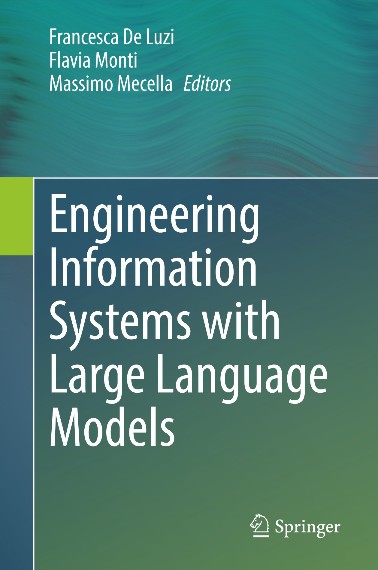
Engineering Information Systems With LLMs By Francesca De Luzi
The rapid advancement of Generative AI and specifically large language models (LLMs) is transforming the landscape of information systems (IS) engineering by offering unprecedented opportunities to support their design, development, maintenance, and reengineering. Starting with an overview of LLM history and foundational concepts, the book delves into practical applications for IS design and development, including prompt engineering, retrieval augmented generation, and multi-agent systems. Through a detailed survey and step-by-step programming guidance, readers will learn how to implement tools leveraging LLMs effectively. The book also addresses ethical considerations, offering insights and guidelines for responsible AI integration. Large language models (LLMs) are advanced AI models designed to process and generate human-like text. They are trained on vast amounts of data and can be used for a wide variety of tasks, such as chatbots, text summarization, code generation, and many others. Python is the most widely used language in this context, but there are also other languages like TypeScript and JavaScript that support LLMs. The prominence of Python in this field is due to its syntactic simplicity and readability, combined with the availability of a rich ecosystem of libraries and frameworks that facilitate the implementation of Machine Learning and natural language processing techniques. The ease of writing in Python allows developers to focus more on the use of models and solving problems, without having to understand complex syntactic details. Python’s compatibility with all major LLMs frameworks makes it ideal for simplifying key processes such as training and fine-tuning. Moreover, integration with data management and visualization libraries, such as Pandas, NumPy, and Matplotlib, helps create a complete and interconnected ecosystem that significantly accelerates the development cycle of LLM applications.
VISITOR COMMENTS (0 )
FILE LIST
Filename
Size
Engineering Information Systems with LLMs by Francesca De Luzi.pdf